Intelligence Quotient (IQ)
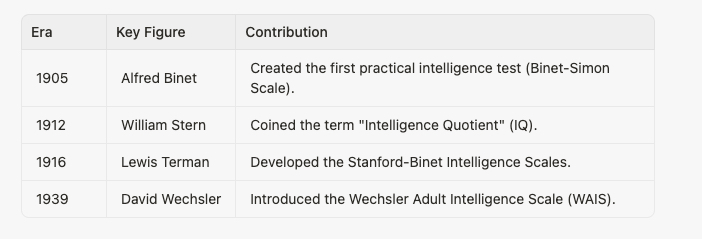
An intelligence quotient (IQ) is a total score derived from a set of standardized tests or subtests designed to assess human intelligence. The abbreviation "IQ" was coined by the psychologist William Stern for the German term Intelligenzquotient, his term for a scoring method for intelligence tests at the University of Breslau he advocated in a 1912 book. Historically, IQ was a score obtained by dividing a person's mental age score, obtained by administering an intelligence test, by the person's chronological age, both expressed in terms of years and months. The resulting fraction (quotient) was multiplied by 100 to obtain the IQ score.> "Intelligence is what is measured by intelligence tests." — Edwin Boring
Modern IQ scores are calculated by comparing the individual's performance to the average performance of others in the same age group. While the term "IQ" is still in common use, most modern tests now use a "deviation IQ" method, where the median raw score of the norming sample is defined as IQ 100 and scores each standard deviation (SD) up or down are defined as 15 IQ points greater or less.
History of Development
The development of intelligence testing began in earnest in the early 20th century. In 1905, French psychologists Alfred Binet and Théodore Simon published the Binet-Simon scale, which focused on verbal abilities and was intended to identify children who needed special academic assistance. Binet emphasized that intelligence is not a single fixed entity and that a child's score could vary over time.In the United States, Lewis Terman of Stanford University adapted the Binet-Simon scale into the Stanford-Binet Intelligence Scales in 1916. This version became the standard for intelligence testing in the U.S. for decades. Later, in 1939, David Wechsler developed the Wechsler-Bellevue Intelligence Scale, which introduced the concept of the "deviation IQ" and provided separate scores for verbal and performance (non-verbal) intelligence.
Scoring and Interpretation
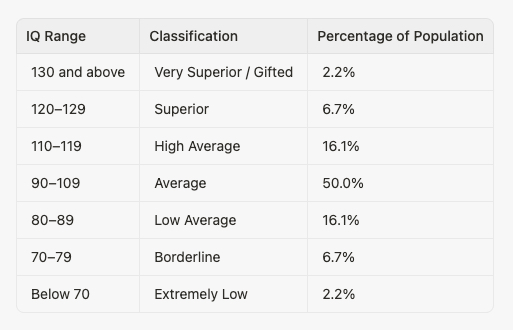
Modern IQ tests are designed so that the results follow a normal distribution, often referred to as the "bell curve." The mean (average) score is set at 100, with a standard deviation of 15. This statistical structure allows for a consistent interpretation of scores across different populations and age groups.Approximately 68% of the population scores within one standard deviation of the mean (between 85 and 115). About 95% of the population falls within two standard deviations (between 70 and 130). Scores above 130 are often classified as "gifted," while scores below 70 may indicate intellectual disability, though such diagnoses also require assessments of adaptive functioning.
Major Types of IQ Tests
There are several widely recognized intelligence tests used today, each with its own specific focus and methodology. The Wechsler Adult Intelligence Scale (WAIS) is currently the most commonly used IQ test for adults, while the Wechsler Intelligence Scale for Children (WISC) is used for younger populations.Other notable tests include:
- Stanford-Binet Intelligence Scales: Now in its fifth edition (SB5), it measures five factors of cognitive ability.
- Raven's Progressive Matrices: A non-verbal test that uses geometric patterns to measure abstract reasoning and "fluid intelligence."
- Woodcock-Johnson Tests of Cognitive Abilities: A comprehensive set of tests designed to measure general intellectual ability as well as specific cognitive functions.
Reliability and Validity
Psychometricians evaluate IQ tests based on their reliability (consistency of results) and validity (whether the test measures what it claims to measure). Most modern, professionally administered IQ tests demonstrate high internal consistency and test-retest reliability.In terms of validity, IQ scores are moderately to highly correlated with various life outcomes, including academic achievement, job performance, and socioeconomic status. However, researchers emphasize that IQ is not the sole predictor of success; factors such as motivation, personality, and social environment play significant roles.
Criticisms and Controversies
Despite their widespread use, IQ tests have been the subject of significant criticism. One major concern is cultural bias, where tests may inadvertently favor individuals from the culture in which the test was developed. This can lead to lower scores for individuals from different linguistic or cultural backgrounds, regardless of their actual cognitive potential.Another area of debate is the Flynn effect, the observation that average IQ scores have increased significantly throughout the 20th century. This phenomenon suggests that environmental factors, such as improved nutrition, better education, and increased environmental complexity, have a profound impact on measured intelligence.
> "The Flynn effect suggests that we are not necessarily getting 'smarter' in a biological sense, but rather becoming more adept at the types of abstract reasoning required by modern life."
Furthermore, critics like Howard Gardner argue that traditional IQ tests are too narrow, focusing primarily on logical and linguistic abilities while ignoring other forms of intelligence, such as musical, spatial, or interpersonal skills. This has led to the development of theories regarding multiple intelligences and emotional intelligence (EQ).
References
1. https://officialiqtests.com/iq-score 2. https://en.wikipedia.org/wiki/Intelligence_quotient3. https://bestiqtests.vercel.app
intelligence iq score iq test